A bicycle is a vehicle — yes, legally bikes are considered vehicles. As such, we should be signaling when we are turning, changing lanes, and stopping. (You do that when you’re driving your car, right?)
When we’re cycling in a group, signaling is extra important for group safety and cohesion. Use hand signals 100 feet before turning, merging, or stopping if you can do so while safely operating your bike. Moreover, we need to communicate with other riders, not only for turning and stopping, but also to indicate hazards in our path, ranging from broken glass to oncoming dog walkers.
Our VBC Ride Committee thought it would be appropriate to review the signals we most commonly use.
- For turning to the left or changing to the left lane, fully extend your left arm.
- For turning to the right or changing to the right lane, either fully extend your right arm or raise your bent left arm (think of a cactus).
- For slowing down or stopping, hold your left arm out with the elbow bent so that your hand is down toward the ground. Alternatively, some riders put a fist behind their back. While the latter gesture may be easily seen by other riders directly behind, we don’t recommend that because it’s less visible to cyclists further back in a group and to nearby motor vehicles.
- For junk in the road, riders use a variety of signals, but the most common is to point at whatever it is and perhaps make a circling motion with your arm.
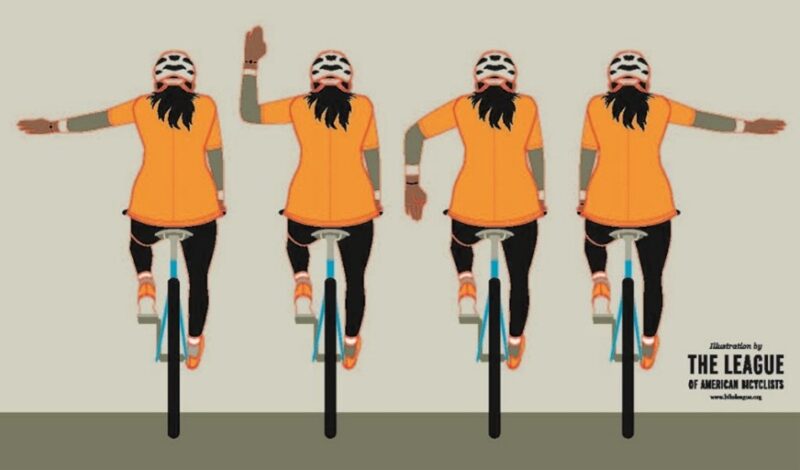
This image shows four common hand signals (from left): Signaling a left turn, signaling a right turn, stopping (also for slowing), and an alternative way of signaling a right turn. In Colorado, bicyclists may use either right turn signal. (Image courtesy of The League of American Bicyclists.)
Using your voice to call out signals and hazards is also important. For instance, there are no standard signals for upcoming obstacles such as runners, walkers, posts, dogs, etc. so we usually call out “runner up” or whatever description is appropriate.
We encourage each rider to “follow the leader” and repeat to pass the information back through the group, both with gestures and verbally. This helps to inform riders at the back of the group of upcoming turns and hazards. Leads and other riders at the front should use signals well in advance of a turn and when safe to do so. But by all means, modify your signaling when necessary to hang onto your handlebars due to speed or hazards.
During the pre-ride talk, the lead should demonstrate what signals she will use. If not, be sure to ask her!
Check out the resources below for more helpful tips and tricks to make your riding experience more comfortable and fun.
Comments are closed.